|
|
| |
|
The Kamiya Papaya Story |
|
|
|
The original "Kamiya
Papaya" was a selection of the "Line 77" introduced
by Dr. Henry Nakasone, College of Tropical Agriculture
and Human Resources at the University of Hawaii
in the early 1960's. The "Line 77" was a large
round fruit with thick flesh and averaging over
three pounds each, some as high as four pounds.
It was also known for being a low bearing tree.
Although it had excellent eating qualities the
drawbacks were for that time was its size and
deep star seed cavity which made it somewhat
difficult to clean out the seeds. Faced with
these drawbacks we began to select seeds for
smaller and somewhat elongated fruit, and after
many fields of trials we finally achieved a
selection that bred true in subsequent plantings.
Following this selection and in the process
of marketing this fruit through Times Super
Markets demand for this fruit became so great
that it required a brand name and hence this
selection became known as the "Kamiya Papaya".
Over the many years of producing and marketing
this papaya we are proud to say that we continue
to serve many loyal and devoted customers who
demand only the best. We hear it over and over
direct from customers that, "once I eat your
papaya I cannot eat any other".
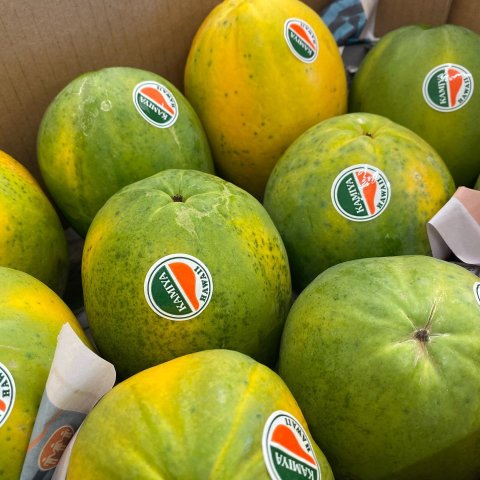
The Kamiya papaya
is a medium sized fruit with orange flesh, thin
rind, mild, but delicate aroma, smooth texture,
and high sugar content. |
|
| |
|
| Our Mission |
|
| |
|
The mission of Kamiya Gold, Inc., is to consistently meet customer expectations for exceptionally high quality papayas.
Our papayas will be the best in terms of sweetness, texture, aroma and color.
One taste and you will agree no other can compare.
|
|
| |
|
| Where to Buy Kamiya Papayas |
|
| |
|
Kamiya Papayas can be found at the following locations:

- Times Super Markets
- Tamashiro Market
- Marukin Market
- Best Market
- Keeeaumoku Produce
- Song Produce
- Kaneohe Crackseed
- CS Mart
|
|
| |
|
| How to Select a Kamiya
Papaya |
|
|
|
Papaya sweetness is
dependant on many factors such as tree health,
fertilization, water availability, pest damage,
and sunshine. But most important is when it
is picked off the tree. Sugar content of the
papaya fruit builds as it is ripening on the
tree and hence the best fruit is tree ripened
- but this is not practical because fruit flies
and birds will get to them before you do. Therefore
at Kamiya Gold, Inc., we harvest fruit that
show signs of ripening, but are not yet ready
to eat. We avoid picking any green fruit and
if unintentionally picked, we discard them.
When shopping for papayas, first it is
good to know how “fresh” or how long since harvest.
Fresh papayas with definite signs of ripening,
i.e. yellow streaks or breaking, together with
bright green skin, will insure sweetness. Avoid
fruits that are bruised or substantially “dinged”.
Selected fruits should be firm to allow handling
and avoid damage.
Allow fruits to ripen naturally at room
temperature and when ripened to desired stage,
refridgerate immediately. Generally, fruit ripeness
is judged by “feel”. Papayas are ready to eat
when it yields to finger pressure. The more
it yileds, the riper it is.
Papayas can be served as a breakfast fruit,
or as a desert. Some prefer to add a dash of
lime or lemon when serving.
|
|
| |
|
| The GMO Story |
|
|
|
What is GMO? This acronym
refers to the process of genetically modifying
an organism or plant to impart certain desired
qualities.
In the case of papayas the present "Rainbow"
papaya is a modified cultivar resistant to the
papaya ringspot virus, a devastating disease
that almost destroyed Hawaii's papaya industry
in early 1990's. Technically the modification
process is analogous to being vaccinated for
certain diseases such as measles, polio, etc.
Although plants do not have immune systems as
in animals pieces of the ringspot virus have
been genetically inserted into the genetic makeup
of the papaya to render it immune to that virus.
The original modification of papaya was
done on the red variety called the sunrise and
this papaya became known as the "Sunup". Subsequent
crosses with the "Kapoho" resulted in the "Rainbow",
the most prevalent fruit on the market today.
To render the "Kamiya" immune to the virus,
the "Kamiya" was crossed with the "Rainbow"
and the resulting hybrid was named the "Laie
Gold" in recognition of where the original crosses
were made.
This original work was performed by Dr.
Maureen Fitch of the USDA, ARS. Today we continue
to enjoy all the qualities of the original "Kamiya"
papaya, but with the added benefit of protection
from papaya ringspot virus.
|
|
| |
Hawai'i Seal of Quality |
| |
KAMIYA GOLD, INC. has been awarded the Hawai'i Seal of Quality by the State of Hawai'i DEPARTMENT OF AGRICULTURE.
This insures that all Kamiya-brand papaya produced and shipped are locally-grown, genuine Hawai'i products.
KAMIYA GOLD, INC. is one of the
Founding Members of this program. To find out more about this program that supports local Hawai'i-grown produce,
please visit the
HAWAII DEPARTMENT OF AGRICULTURE website.
|
|
|
| |
|
| Hawai'i Papaya Industry Association |
|
|
|
KAMIYA GOLD INC. is a member of the
HAWAI'I PAPAYA INDUSTRY ASSOCIATION.
The Hawai'i Papaya Industry Association envisions nutritious, quality Hawaii grown papayas will be available to consumers worldwide.
The association exists to promote the improvement of business conditions in the State of Hawai'i for the papaya industry,
including the conditions relating to cultivation, distribution, sales, and use of papayas.
We are committed to this purpose for the improvement and orderly development of the papaya industry ... through research, education and cooperation on a non-partisan basis.

|
|
|
|
|